Apartment Maintenance Charges in Chennai: What Buyers Must Know in 2026
Most flat buyers in Chennai focus entirely on the purchase price and home loan EMI — and completely overlook the monthly maintenance charges that will form a fixed ongoing cost for as long as they own the property. These charges can range from Rs. 1,500 to Rs. 8,000 per month depending on the project, and understanding what is included, how they are calculated, and what your rights are as a flat owner can save you significant money and frustration.
What Are Apartment Maintenance Charges?
Maintenance charges are the monthly fees collected from flat owners to cover the operating costs of a residential apartment complex. They fund everything from the security guards at the gate to the electricity running the lifts, the plumber who fixes common area leaks, and the landscaping team maintaining the grounds.
In Chennai, maintenance is typically managed by a Residents' Welfare Association (RWA) formed by the flat owners after the builder hands over the common areas. Until the RWA is formed, the builder collects and manages maintenance funds.
How Are Maintenance Charges Calculated?
There are two common methods used by apartment complexes in Chennai and across Tamil Nadu.
Per sqft method: A fixed rate per sqft of your flat's built-up area — typically Rs. 2 to Rs. 5 per sqft per month. A 1,000 sqft flat at Rs. 3/sqft pays Rs. 3,000/month
Equal share method: Total operating costs divided equally among all flats regardless of size
Hybrid method: Base charge per sqft plus equal share of certain fixed costs like security and lifts
What Do Maintenance Charges Cover?
A well-run apartment association in South Chennai will use maintenance funds to cover the following:
Security guard salaries and gated entry systems
Common area electricity — lift, staircase lights, pump motors, gate lights
Water supply — overhead tank motor electricity and water board charges for common areas
Housekeeping and sweeping of common areas, corridors, and parking
Lift annual maintenance contract (AMC)
Generator fuel and maintenance for power backup
Gardening and landscaping
Minor plumbing and electrical repairs in common areas
Sinking fund contributions for major future repairs
What Is a Sinking Fund and Why Does It Matter?
A sinking fund is a separate reserve fund collected monthly or annually to cover major future expenses — repainting the building, replacing the lift after 15 years, waterproofing the terrace, or resurfacing the parking area. Well-managed apartment complexes in Chennai collect Rs. 500 to Rs. 2,000 per flat per year into a sinking fund.
When evaluating an apartment to buy, ask whether the complex has an active sinking fund. A complex without one will face a sudden large levy on all owners when a major repair is needed — which creates conflict and financial stress.
How to Evaluate Maintenance Charges Before Buying
Before committing to any apartment in Tambaram, Chromepet, or Selaiyur, ask the builder or RWA these specific questions:
What is the current monthly maintenance charge per sqft or per flat?
What does it include and exclude specifically?
Is there a separate sinking fund and how much is collected?
How often have charges been increased in the last 3 years?
Is the maintenance managed by the builder or an independent RWA?
Are there arrears from existing flat owners that could burden the association?
Typical Maintenance Charges in South Chennai 2026
Based on current market data across South Chennai localities in 2026, maintenance charges typically fall in these ranges:
Basic amenities complex (security, lifts, common lights): Rs. 1,500 to Rs. 2,500 per month
Mid-range complex with gym, garden, CCTV: Rs. 2,500 to Rs. 4,500 per month
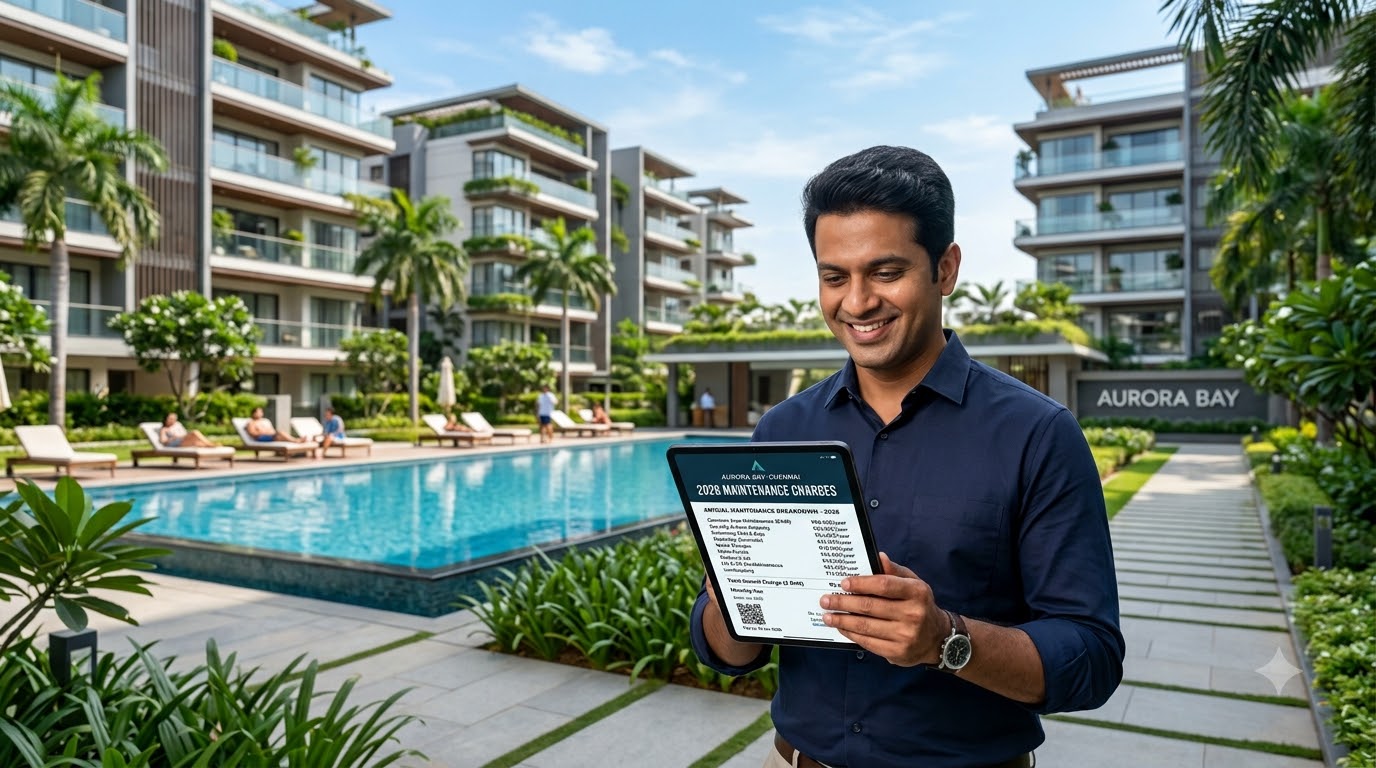
Premium complex with pool, clubhouse, 24hr security: Rs. 5,000 to Rs. 8,000 per month
GCC Group projects: structured transparently with itemised breakdown provided at handover
Frequently Asked Questions
Are maintenance charges included in the flat price?
No. Maintenance charges are an ongoing monthly cost separate from the purchase price and home loan EMI. At the time of purchase, builders may collect an advance maintenance deposit of 12 to 24 months upfront. Thereafter, charges are collected monthly or quarterly by the RWA.
Can the RWA increase maintenance charges?
Yes. The RWA can increase maintenance charges based on rising operating costs — utility bills, staff salaries, and AMC costs increase annually. A typical well-run complex in Chennai increases charges by 5 to 10% every 2 to 3 years. Any increase above a certain threshold requires a vote among flat owners at the annual general body meeting.
What happens if I do not pay maintenance charges?
Non-payment of maintenance charges allows the RWA to restrict access to common amenities like the gym, pool, and clubhouse. In extreme cases, the RWA can take legal action to recover dues. Under Tamil Nadu apartment laws, unpaid maintenance charges can be treated as arrears and recovered accordingly.
Enquire About Maintenance Charges — GCC Group South Chennai
Conclusion
Maintenance charges are a permanent part of flat ownership in Chennai and deserve as much attention as the purchase price. Understanding what you are paying for, how it is managed, and how it may increase over time will help you budget accurately and choose a well-run complex. GCC Group provides a transparent maintenance structure for all its South Chennai projects — ask our team for the full breakdown.